“But what if we say the wrong thing and the caller hangs up on me?” 😥
Our Jan cohort of new Samaritans volunteers for my branch was in session, and a new volunteer asked this question a bit nervously.
I think that if we can stick two these two rules, we are less likely to say the wrong thing:
1️⃣Don’t try to solve their problem
2️⃣Don’t be judgemental – in your tone, pitch or even the words that you use
As a listener, we sit alongside our caller (metaphorically) on a metaphorical bench, and we… listen.
We don’t advice.
We don’t judge.
We don’t presume we know what’s going on.
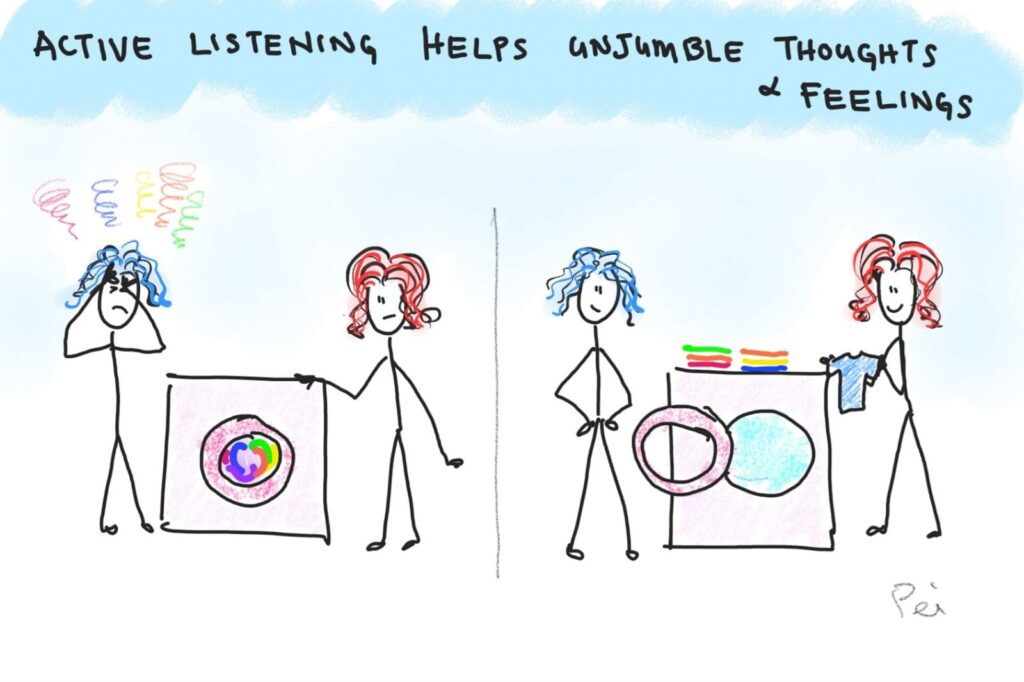
And that will allow us to be a deeply empathetic active listener.
We hold a safe space for our callers to share their thoughts and emotions, and through gentle curious questioning, we may help them reframe their situation and allow them to see a way forward. 🎯
When we are in crisis, our thoughts and feelings are mixed and jumbled up, like a running tumble dryer, and it can be incredibly helpful when someone helps us fold things up so we can see thing clearly. 👕👖👗🥼
When I am on shift, I hang up my #ProjectManager hat and take on that of a listener.
It’s not easy 😕
Especially when we get domestic violence calls (those hit deep) and it takes all my might to restrain myself from telling them to get out of that situation. 😔
But I remind myself that I am not there to try and fix their problems.
I am there to listen.
To give them space to breathe.
To share without judgement.
To help them explore options and possibilities so that maybe… they may find a way to hang on for another day.
If you’re in a good place, you might want to consider volunteering for an outstanding organisation like #Samaritans, or any other organisations that resonate with you. ❤️
If you’re struggling, please reach out and call us freephone 116 123 from the UK or 988 for the crisis phoneline in USA.
You don’t have to go through it alone. 🌹